 Libzbook
Growing your library
How to Turn Study Library Enquiries into Admissions
Record every walk-in, call and WhatsApp enquiry, follow up on the right day and learn which sources actually bring students to your study library.
Most enquiries are lost by forgetting, not by price
A student walks in, asks about the morning shift and the fee, and says they will come back after talking to their parents. Someone else calls about an AC hall. A third person messages on WhatsApp late at night. Each one is a likely admission, and most are never contacted again. The number goes into a diary, the diary gets full, and nobody owns the follow-up.
You do not need an expensive sales system to fix this. You need one list, a next step for each person, and a daily habit.
Record every enquiry in one place
Whatever tool you use, capture the same few details for each enquiry:
- Name and mobile number.
- Where they came from: walk-in, phone, WhatsApp, your booking page, a poster, a referral, Google or social media.
- What they want: shift, plan, budget, exam, any special need such as a quiet corner.
- The next step and its date: "Call on Friday", "Coming to see the hall on Saturday".
The source matters more than it seems. After a few months it tells you whether your posters, your Google listing or word of mouth bring the students who actually join.
Give each enquiry a stage
A simple set of stages shows where every person stands:
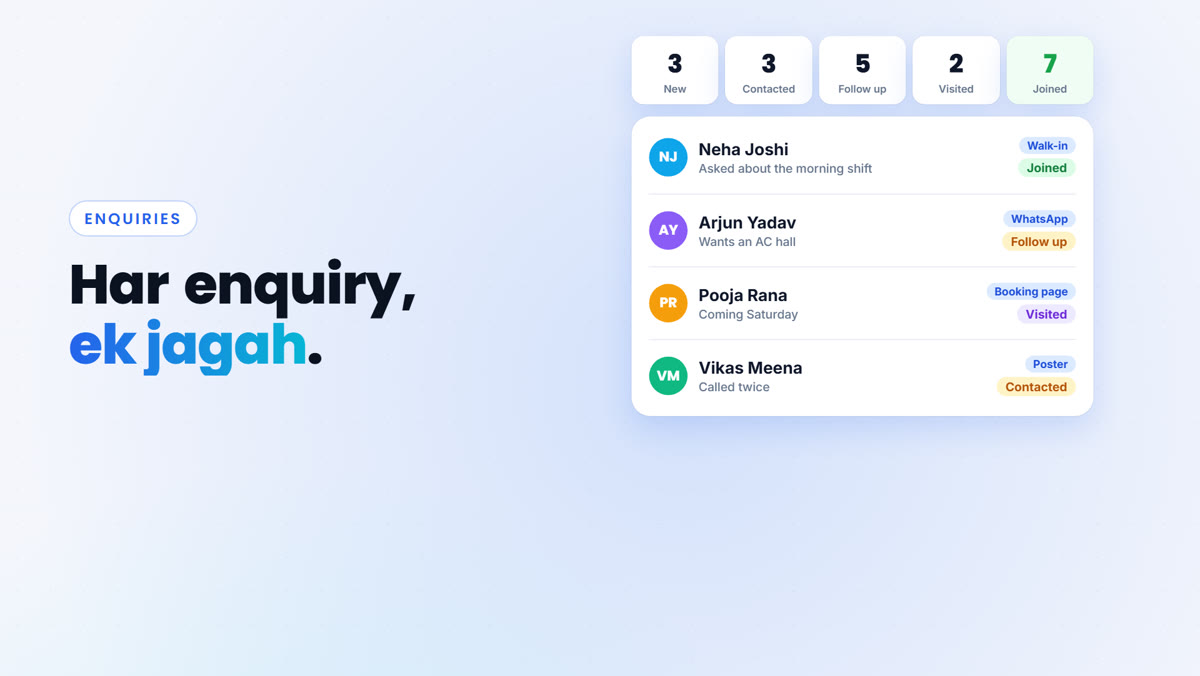
- New: they asked, nobody has contacted them yet.
- Contacted: you have spoken to them.
- Follow up: you have agreed to get back to them on a date.
- Visited: they came to see the library.
- Joined: they booked a seat.
- Lost: they went elsewhere. Note the reason, such as price, distance or timing.
In Libzbook, enquiries live in Marketing → Enquiries with exactly these stages. Each enquiry keeps its source, notes, calls, WhatsApp messages and visits, and can be assigned to a member of your team.
Follow up on the right day, every day
The most important habit is a short daily follow-up list: the people you promised to contact today. Work through it at the same time each morning, log what happened, and set the next date before moving on.
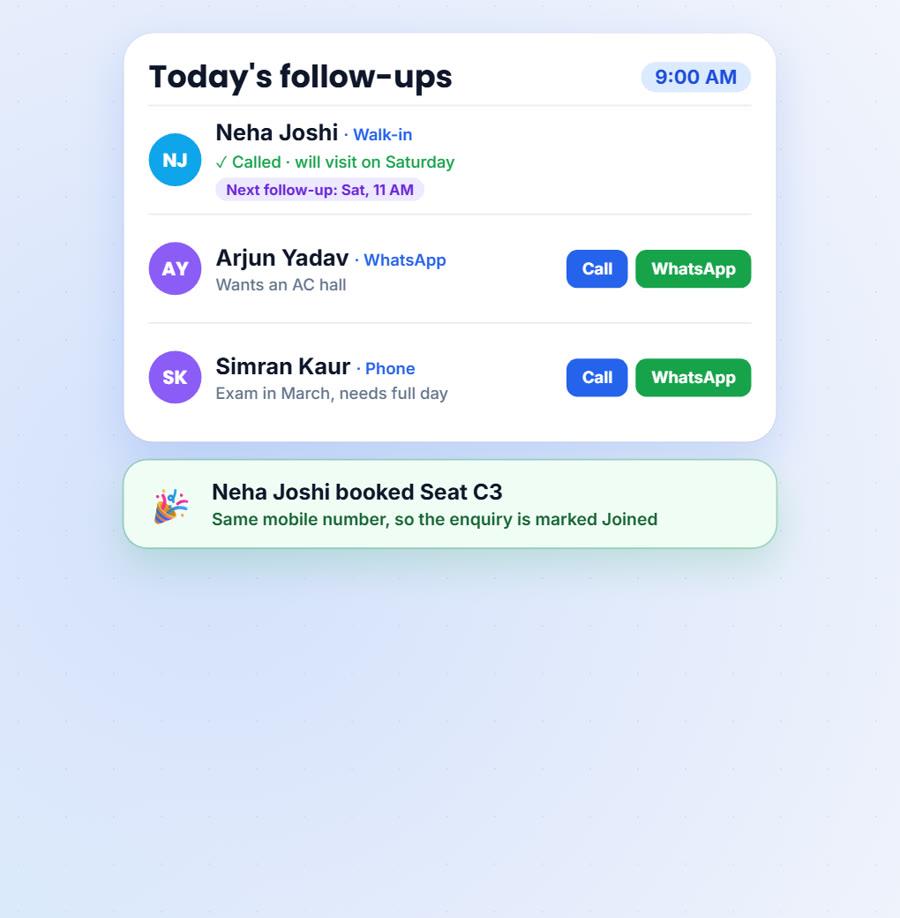
In Libzbook, each person gets their follow-ups for the day at 9 AM, and enquiries not assigned to anyone go to the admins. When you log a call or note, you can set the next follow-up in the same step. When the same mobile number later books a seat, the enquiry is marked Joined by itself, so nobody has to remember to update it.
Keep it polite and useful
A good follow-up answers a question rather than repeating a sales pitch:
- Share something specific: the current free seats in their preferred shift, the fee, or a photo of the hall.
- Offer a visit at a time that suits them.
- If they have chosen another library, thank them, mark the enquiry lost with the reason, and stop calling.
If your library is full when they are ready, add them to your waitlist instead of losing them.
Measure what works
Once a month, look at four numbers: how many enquiries came in, how many joined, which source brought the most joins, and the most common reasons people did not join. Libzbook's enquiry report shows these for a chosen period, including the number of days it usually takes someone to join.
These numbers are more useful than any guess. If walk-ins join far more often than callers, invest in signage and the entrance. If many people are lost on price for one shift, revisit that plan. If enquiries from your online booking link convert well, share it more often; the online booking overview explains how that page works.
We make Libzbook, and the steps above describe how its enquiries work today. The illustrations use sample names and numbers; they are not screenshots of a real library.